Author: admin

  • FBR Faces Significant Revenue Shortfall: A Closer Look at the 9-Month Performance

    FBR Faces Significant Revenue Shortfall: A Closer Look at the 9-Month Performance

    By: Sardar Shahid Khan

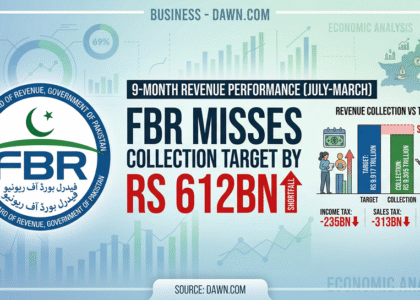
    The Federal Board of Revenue (FBR) has reported a substantial revenue collection shortfall of Rs612 billion for the first nine months (July–March) of the fiscal year 2025–26. While the total collection reached Rs9.305 trillion, it fell short of the projected target of Rs9.917 trillion set for this period.

    This gap highlights the growing fiscal pressures on the national exchequer, even as the board recorded a 10% year-on-year growth compared to the Rs8.449 trillion collected during the same period last year.

    Key Breakdown of the Shortfall

    The deficit is spread across several major tax heads, reflecting broader economic challenges:

    • Income Tax: Collected Rs4.636 trillion against a target of Rs4.871 trillion, resulting in a Rs235 billion shortfall.
    • Sales Tax: Faced the largest deficit of Rs313 billion, with total collections reaching Rs3.104 trillion against a projected Rs3.417 trillion.
    • Customs Duty: Recorded a shortfall of Rs70 billion, bringing in Rs956 billion against a target of Rs1.026 trillion.
    • Federal Excise Duty (FED): In a rare positive turn, FED collection reached Rs608 billion, slightly surpassing the projected target of Rs603 billion.

    Why the Shortfall?

    Several factors contributed to the missing targets in March specifically:

    1. Economic Slowdown: War-related uncertainties and supply chain disruptions have dampened economic activity, impacting both customs and sales tax.
    2. Increased Refunds: To support business liquidity during these uncertain times, the FBR deliberately issued higher refunds. Total refunds reached Rs61 billion in March 2026, compared to Rs34 billion in the same month last year.
    3. Revised Targets: The IMF has already revised the FBR’s annual tax collection target downward by Rs150 billion in its last review, signaling a recognition of these fiscal hurdles.

    What This Means for Businesses

    For taxpayers and corporations, this shortfall often leads to intensified enforcement measures as the FBR strives to close the gap in the final quarter of the fiscal year. Staying compliant and ensuring all documentation is in order is more critical than ever during these periods of high regulatory scrutiny.


    Reference: For more detailed insights, you can read the original report at Dawn.com: FBR misses collection target by Rs612bn.

  • Accountability at the Top: The Rs. 250 Million Cigarette Scandal & The FBR Chairman

    By: Sardar Shahid Khan-Foubder

    In a move that has sent shockwaves through Pakistan’s regulatory landscape, a Senate Standing Committee subcommittee has issued a stern directive: Accountability must reach the highest offices of the land.

    ​The Federal Investigation Agency (FIA) has been ordered to take drastic measures if the Chairman of the Federal Board of Revenue (FBR) and involved tax officers fail to provide answers regarding a massive theft of smuggled goods. At Corptax Digital, we believe that transparency in tax administration is the foundation of a healthy economy. Here is a breakdown of the “Cigarette Theft Scandal” and what it means for the state of compliance in Pakistan.

    ​The Scandal: Rs. 25 Crore Gone from Customs

    ​The case involves the disappearance of smuggled cigarettes worth approximately Rs. 250 million (25 Crore) from a secure FBR/Customs warehouse.

    • The Allegation: High-ranking tax officials are suspected of either negligence or direct involvement in the “theft” of these seized goods.
    • The Senate’s Reaction: Senator Talha Mahmood, leading the subcommittee, expressed outrage over the absence of high-ranking officials at the briefing. He has directed that if the FBR Chairman and relevant officers do not appear by April 2, they should be brought before the committee in handcuffs.

    ​Corruption & Real Estate: A Growing Trail

    ​One of the most alarming revelations in the committee meeting was the mention of a Deputy Commissioner of Inland Revenue who allegedly purchased an expensive house shortly after the theft occurred.

    • ​This highlights a recurring concern for taxpayers: while the FBR pushes for a “Documented Economy” for citizens, the internal accountability of its own officers is being called into question by the Senate.

    ​FIA Intervention and Evidence

    ​FIA Deputy Director Afzal Niazi confirmed that the agency has gathered “substantial evidence” regarding:

    1. The Tobacco Company involved in the smuggling.
    2. The Vehicles used to transport the stolen goods.
    3. Digital and Physical Evidence linking the theft to specific warehouse operations.

    ​Why This Matters to You (The Taxpayer)

    ​As a firm of financial consultants and lawyers at Corptax Accountants LLP, we often see our clients facing strict scrutiny for minor filing errors. This scandal serves as a reminder that:

    • Rule of Law applies to everyone: From a small shopkeeper to the Chairman of the FBR, nobody is above the law.
    • Systemic Reform is Needed: For Pakistan to truly document its economy, the institutions managing our taxes must be beyond reproach.
    • Professional Representation is Key: In an environment where the regulatory landscape can be volatile, having a legal and tax partner who understands the “inner workings” of the system is vital for protecting your business interests.

    ​Our Take at Corptax Digital

    ​While this scandal is a blow to the image of our tax regulators, the Senate’s firm stance is a positive sign for the future of transparency. We will continue to monitor this case closely as the April 2 deadline approaches.

    Stay Informed. Stay Compliant. Stay Protected. For expert advice on navigating FBR regulations or ensuring your business is audit-ready, Contact Corptax Accountants LLP today.

  • New Tax Era in Pakistan: 5 Things Every Business Owner Must Know in 2026

    New Tax Era in Pakistan: 5 Things Every Business Owner Must Know in 2026

    The taxation landscape in Pakistan is shifting rapidly. With the Federal Board of Revenue (FBR) pushing for a fully “Documented Economy,” staying compliant is no longer just about avoiding fines—it’s about business survival.

    Whether you are a startup in Lahore or an established multinational, here are the most critical updates for Tax Year 2026 that will impact your bottom line.

    1. The “Filer vs. Non-Filer” Gap is Widening

    In 2026, the cost of being a “Non-Filer” has reached an all-time high. The FBR has significantly increased withholding tax rates for those not on the Active Taxpayer List (ATL). From cash withdrawals (now up to 0.8%) to property transactions and vehicle registrations, non-filers are paying double—or even triple—the tax compared to active filers.

    Expert Tip: Being a “Filer” isn’t just a status; it’s a financial saving strategy.

    2. Digitalization of E-commerce (Section 6A)

    If you sell goods or services online through a website or a marketplace, the FBR’s new Section 6A now treats these as “Digital Presence” transactions.

    • Automatic Collection: Payment intermediaries (banks and gateways) and couriers (for Cash on Delivery) are now mandated to collect sales tax at the point of transaction.
    • Registration is Mandatory: Online sellers must now be registered and integrated with FBR systems to continue operating legally.

    3. Relief for the Salaried Class (Lower & Middle Tiers)

    There is a “ray of hope” in the latest Finance Act for salaried individuals. Tax slabs have been revised to provide relief:

    • Incomes up to Rs. 600,000 remain tax-free.
    • Significant tax cuts (up to 80%) have been applied to the lower income brackets (Rs. 600k – Rs. 1.2M) to boost disposable income.However, higher earners (above Rs. 4.1M) still face a top rate of 35%.

    4. Corporate Tax Stability & Super Tax

    The standard corporate tax rate remains steady at 29%, with a concessional 20% for “Small Companies.” However, the Super Tax (ranging from 1% to 10%) continues to apply to high-earning entities with income above Rs. 150 million.

    5. The Push for “Delfin” Level Accuracy

    With the introduction of IRIS 2.0 and real-time point-of-sale (POS) integration requirements, manual bookkeeping is becoming a liability. Businesses are now required to maintain digital audit trails.

    • The Risk: Inaccurate records or cash payments exceeding Rs. 200,000 can lead to the “disallowance of expenses,” meaning you pay tax on money you already spent on your business.

    How Corptax Digital Can Help

    Navigating these changes requires more than just a calculator; it requires a strategic partner. At Corptax Accountants LLP, we combine legal expertise with cutting-edge technology like Delfin ERP to ensure your business remains 100% compliant while optimizing your tax liability.

    Don’t wait for a notice to arrive. Contact us today for a Free Tax Consultation or use our Online Tax Calculator to estimate your 2026 liability.

  • Choosing the Right Path: A Guide to Business Registration in Pakistan (2026)

    Choosing the Right Path: A Guide to Business Registration in Pakistan (2026)

    Starting a business is an exciting journey, but the first—and most critical—step is choosing the right legal structure. In Pakistan, your choice impacts everything from your personal liability to how much tax you pay and your ability to attract investors.

    At Corptax Digital, we help hundreds of entrepreneurs move from “idea” to “incorporated.” Here is a breakdown of the most common business registrations in Pakistan for 2026.


    1. Sole Proprietorship (The Simple Start)

    Ideal for freelancers, consultants, and small retail shops.

    • Registration: Registered only with the FBR to obtain a National Tax Number (NTN) under a business name.
    • Liability: Unlimited. You and your business are the same legal entity. If the business owes money, your personal assets (house, car) are at risk.
    • Best For: Low-risk, solo-run businesses testing the market.

    2. Partnership / Association of Persons (AOP)

    Best for 2 or more partners who want to share resources without the complexity of a full company.

    • Registration: Registered with the local Registrar of Firms (Provincial level) and the FBR.
    • Liability: Joint and several. All partners are personally liable for the business’s debts.
    • Best For: Small professional firms (Doctors, Lawyers, Accountants) or family-run businesses.

    3. Private Limited Company (The Gold Standard)

    The most popular choice for startups and growing businesses aiming for high credibility.

    • Registration: Registered with the Securities and Exchange Commission of Pakistan (SECP) via the new eZfile portal.
    • Liability: Limited. Your personal assets are protected. If the company fails, your loss is limited only to the amount you invested in shares.
    • Best For: Tech startups, export businesses, and any entity looking to raise capital or work with international clients.

    4. Single Member Company (SMC-Pvt Ltd)

    Enjoy the benefits of a Private Limited Company without needing a partner.

    • Registration: SECP (eZfile).
    • Liability: Limited.
    • Requirement: You must appoint a “Nominee Director” (usually a family member) who only steps in if the primary owner is unable to run the business.
    • Best For: Solo entrepreneurs who want professional status and asset protection.

    5. Limited Liability Partnership (LLP)

    A modern hybrid that combines the flexibility of a partnership with the protection of a company.

    • Registration: SECP.
    • Taxation: Unlike other jurisdictions, LLPs in Pakistan are currently taxed at the corporate level.
    • Best For: Professional service providers and consultants who want a middle ground between an AOP and a Pvt Ltd.

    The 2026 Registration Checklist

    Before you start, ensure you have the following ready:

    1. Unique Business Name: Check availability on the SECP name search tool.
    2. CNIC/Passport Copies: For all directors/partners.
    3. Registered Office Address: A utility bill or rent agreement in the business’s name.
    4. Principal Line of Business: A clear description of what your company will actually do.

    Why Register with Corptax Digital?

    The registration process involves more than just filling out forms—it’s about setting a foundation for growth.

    • Legal Shield: Our lawyers ensure your Memorandum of Association (MOA) protects your interests.
    • Tech-Ready: We integrate your new business with Delfin ERP from day one, so your bookkeeping is audit-ready.
    • Post-Reg Support: We don’t just give you a certificate; we handle your NTN, Sales Tax (STRN), and Chamber of Commerce registrations.

    Ready to legalize your dream? Book a free consultation with our Lahore team today.

  • Beyond the Register: Why Digital Transformation is No Longer Optional for Pakistani SMEs

    Beyond the Register: Why Digital Transformation is No Longer Optional for Pakistani SMEs

    For decades, the “Kacha Register” (manual ledger) was the heartbeat of Pakistani small businesses. But as we move through 2026, the Federal Board of Revenue (FBR) and SECP are making one thing clear: The future of business in Pakistan is digital.

    At Corptax Digital, we are seeing a massive shift. Business owners are no longer asking if they should go digital, but how fast they can do it. Here is why digital transformation is the ultimate competitive advantage for your business today.

    1. Real-Time FBR Compliance (The POS Revolution)

    The FBR’s “Digital Invoicing” mandate is expanding across Tier-1 retailers and wholesalers. If you are still manually calculating Sales Tax, you are at a high risk of audit flags.

    • The Solution: Systems like DelfinPOS automatically sync every transaction with the FBR server, generating a verifiable QR code on every receipt. This doesn’t just keep you legal; it builds immense trust with your customers.

    2. From Hindsight to Foresight with ERP

    Traditional accounting tells you what happened last month. A modern ERP (Enterprise Resource Planning) system tells you what is happening right now.

    • Inventory Control: Stop losing money on expired stock or “leakage.”
    • Cash Flow Management: Delfin ERP provides a bird’s-eye view of your payables and receivables, ensuring you never run out of liquidity during peak seasons.

    3. The End of “Audit Anxiety”

    When the tax authorities or auditors visit, the most stressful part is finding old receipts and reconciling bank statements.

    • Digital Trails: Digital transformation creates an immutable audit trail. Every expense is categorized, and every voucher is attached to a digital record. When your books are “born digital,” audits become a routine check rather than a business-halting crisis.

    4. Data-Driven Decision Making

    In 2026, data is more valuable than gold. By moving your business to a digital platform, you can answer critical questions instantly:

    • Which product is my highest margin item?
    • Which salesperson is performing the best?
    • What is my projected tax liability for the next quarter?

    5. Scaling Beyond Borders

    If your goal is to export or work with international clients, they will demand digital transparency. Modern corporate advisory now requires businesses to have robust internal controls—something that is impossible to maintain on paper as you grow.


    Conclusion: Start Small, But Start Now

    Digital transformation doesn’t mean replacing your entire staff with robots. It means giving your team the tools—like Delfin ERP—to work smarter, stay compliant, and focus on growth instead of paperwork.

    Is your business ready for the digital era? At Corptax Accountants LLP, we don’t just give you software; we provide the legal and financial framework to make it work for you.

    Request a Demo of Delfin ERP & POS Today or visit our office in New Garden Town, Lahore, for a personalized consultation.

  • Digital Dollars & FBR: A 2026 Compliance Guide for Freelancers and Overseas Pakistanis

    Digital Dollars & FBR: A 2026 Compliance Guide for Freelancers and Overseas Pakistanis

    For the thousands of Pakistanis working as freelancers or living abroad while investing back home, 2026 has brought a major wave of “Digitalization.” The days of unmonitored foreign inflows are over, but with the right compliance, these changes can actually work in your favor.

    At Corptax Digital, we bridge the gap between global earnings and local regulations. Here is what you need to know to stay “Active” on the FBR list while protecting your income.

    1. The 0.25% Concessional Tax: Are You Still Eligible?

    The good news is that IT and IT-enabled services (ITeS) still enjoy a reduced tax rate of 0.25% on foreign remittances. However, in 2026, the FBR has “closed the loop.” To qualify, you must now:

    • Be a registered NTN holder.
    • File your annual Income Tax returns on time.
    • Receive payments through formal banking channels in a dedicated “Freelancer Account.”
    • Submit a Withholding Tax (WHT) Exemption Certificate if your bank attempts to deduct standard rates.

    2. Overseas Pakistanis: The “Filer” Advantage

    If you are living in the UAE, UK, or USA and buying property in Pakistan, your “Filer” status is more important than ever.

    • Property Transactions: Non-filers now face significantly higher withholding taxes on the purchase and sale of immovable property.
    • IRIS 2.0: You can now manage your entire tax profile via FBR IRIS 2.0 without ever stepping foot in Pakistan. Our legal team at Corptax Accountants LLP specializes in managing these digital portals for overseas clients.

    3. Automated Tracking of “Digital Presence”

    Under the new Section 6A, the FBR is now collaborating with international payment gateways and local courier services to track e-commerce and digital service sales. If you are selling digital products (SaaS, E-books, or Courses) to Pakistani consumers, you are now required to register for Sales Tax, even if you are based abroad.

    4. Avoiding the “Non-Filer” Penalty on Investments

    Many overseas Pakistanis keep savings in Pakistani bank accounts. In 2026, the tax on “Profit on Debt” (Bank Interest) is nearly double for non-filers. By appearing on the Active Taxpayer List (ATL), you protect your investment returns from being eroded by excessive withholding.

    5. Why Professional Representation Matters

    As lawyers and consultants, we understand that “tax” isn’t just about numbers; it’s about legal standing. Misreporting a foreign remittance as “Gift” instead of “Foreign Income” can lead to unnecessary audits and wealth reconciliation issues later.


    Conclusion: Global Income, Local Peace of Mind

    Whether you are scaling your freelance agency or securing your family’s future through property in Lahore, digital compliance is your shield. At Corptax Digital, we combine the power of Delfin ERP for your business tracking with expert legal advice to keep your global journey smooth.

    Are you an Overseas Pakistani or a Freelancer? Get a Custom Tax Compliance Roadmap Today.